I Went Looking for Who’s Actually Behind My Peptides. Here’s What a Week of Reading Labels Turned Up.


Nobody paid me to write this. I don’t sell peptides, I don’t have a code to give you, and there’s no button at the bottom of this page. If you click a link here, it goes to an FDA filing, a PubMed record, or StatPearls, places where you can check my work yourself. Reviewed as of June 2026.
The question I had
It started with a dumb, specific worry: if a vial of something I injected made me feel wrong at 11pm on a Tuesday, who would actually pick up the phone? Not customer service. Not a Discord mod. A person with a license who knew what I’d taken and was on the hook for what happened next.
So I stopped reading marketing copy and started reading regulatory filings instead. I wanted one answer: across the peptide sites people actually search for, who has a real doctor in the loop, and who’s just shipping a vial with a sticker on it?
What I dug up first: the letters that changed the whole conversation
I almost skipped past this, thinking it was boilerplate. It wasn’t. Through late 2025 and into 2026, the FDA put the entire research-chemical peptide market on notice, and I mean that literally, in writing.
A regulatory-law write-up I found documented more than fifty FDA warning letters landing in a single stretch in September 2025, aimed at compounded GLP-1 marketing and at peptides sold “research use only” while being advertised for human use. The compounds named included semaglutide, tirzepatide, retatrutide, BPC-157, and certain SARMs [C2]. Then, on March 31, 2026, letters went out to sellers including Gram Peptides, Prime Sciences, and Pink Pony Peptides, calling their products unapproved new drugs. I pulled the actual language from the Gram Peptides letter because I didn’t believe the paraphrase would do it justice: “despite statements on your product labeling marketing your products for ‘Research Use Only,’ and ‘not intended for human consumption, medical use, or veterinary use,’ evidence obtained from your website establishes that your products are intended to be drugs for human use” [C1].
Read that twice, the way I did. It’s not about one seller. It’s the FDA saying, out loud, that the “for research use only” sticker every gray-market site relies on is not the shield people assumed it was. If the product page talks about appetite or recovery, and the checkout sells you syringes and bacteriostatic water to go with it, the label is wallpaper.
The thing I kept coming back to: not the molecule, the follow-up
Here’s what I decided actually separates a safe source from a risky one, and it isn’t the peptide itself. It’s whether a licensed clinician reviewed your history, screened you for reasons this specific compound might be a bad idea for you, decided whether to prescribe at all, and is still reachable three weeks later when you have a question or a side effect.
That last piece, the follow-up, is the part I couldn’t find anywhere in the research-chemical world, because the relationship there ends the moment your tracking number updates.
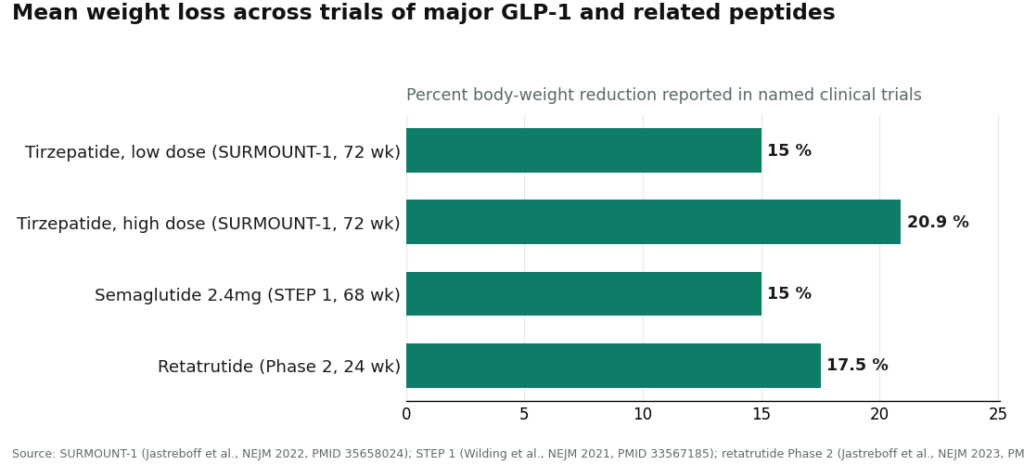
This isn’t abstract when you look at what the popular metabolic peptides actually do. Semaglutide is a GLP-1 receptor agonist, tirzepatide works on both GIP and GLP-1 receptors, and both push on the incretin system, slowing digestion, suppressing glucagon, making you feel full [C6]. In the SURMOUNT-1 trial, tirzepatide produced average weight loss of 15.0% to 20.9% depending on dose, over 72 weeks [C4]. In STEP 1, semaglutide at 2.4 mg got people to roughly 15% over 68 weeks [C5]. A related compound, retatrutide, hit around 17.5% by 24 weeks in a Phase 2 trial, though it’s still investigational and not approved [C7]. I’ll come back to those numbers below, but the point that stuck with me is this: these are strong drugs that need titration and monitoring. Doing that alone, from an unlabeled vial with no instructions, is a different risk profile than doing it with someone watching your dose.
Where I found a doctor actually in the loop
I went hunting for platforms where a physician isn’t decoration on a landing page but the actual structure of the thing. Two stood out clearly enough that I’d rank them, in this order, for this specific reason.
FormBlends came out on top for me. It connects patients with independent, licensed physicians for prescription access to compounded peptides and GLP-1 medications, made by state-licensed 503A compounding pharmacies, in 47 states. A physician reviews your intake and builds an actual protocol. Every medication requires a consultation and a prescription. There’s follow-up. What I appreciated more than the structure, honestly, was the tone: FormBlends says plainly, in its own materials, that compounded medications are not FDA-approved and haven’t been evaluated by the FDA for safety, effectiveness, or quality, and that its pharmacies follow USP <797> and <800> compounding standards. It tells you which compounds are approved drugs, which are compounded, and which are still research-status, rather than flattening it all into “clinically proven.” The catalog itself reads like the internet’s actual peptide wish list: weight-loss and metabolic compounds (semaglutide, tirzepatide, tesamorelin), recovery peptides (BPC-157, TB-500 blends), growth and performance secretagogues like sermorelin, longevity compounds (NAD+, epithalon), sexual wellness (PT-141), skin and hair (GHK-Cu), and cognitive peptides. One small, practical thing I noted: patients who log their dose and side effects, using something like the FormBlends tracker app, give their clinician a much clearer picture at the next check-in. That app logs, it doesn’t sell anything. But none of that follow-up infrastructure would matter if there weren’t a doctor on the other end reading it.
HealthRX.com landed right behind it, at #2, for the same underlying reason: licensed clinical oversight first, medication dispensed through actual pharmacy channels instead of sold like a chemistry-set kit. What it adds is the screening layer and the ongoing check-in, the exact thing missing from every research-chemical name further down this list. Which one is right for you probably comes down to which is licensed in your state.
The names people actually search for, described for what they are
I want to be straight about why the following names appear here at all: people type them into search bars constantly, and pretending they don’t exist doesn’t make the risk go away. Every single one below is a research-chemical retailer. None is a medical provider. Read the description of each one as the warning itself.
Every one of these sells peptides labeled “for research use only” or “not for human consumption.” That’s not a wink, it’s the legal ground the product stands on, and the second it’s marketed for a person to inject, it becomes an unapproved new drug, which is exactly the gap the FDA went after in 2026 [C1][C2]. No doctor. No prescription. No licensed pharmacy dispensing it. No follow-up. If a vial turns out mislabeled or contaminated, nobody has recall authority and nobody is responsible.
A couple of names sit in a middle category I hadn’t expected before I started this. MeriHealth, at #3, brings physician supervision into peptide and GLP-1 therapy built specifically around female physiology, with a licensed clinician reviewing history, screening for contraindications, and prescribing through a licensed compounding pharmacy when it’s appropriate. Same disclosure as everyone in the supervised tier: compounded medications are not FDA-approved finished drugs. The women-centered intake is what separates it from the pure research-chemical sellers below. WomenRX, at #4, rounds out that tier with physician-led telehealth for women seeking compounded GLP-1s and peptide protocols through licensed pharmacies, with intake and follow-up built around the actual health concerns women bring to a prescriber, including metabolic health and weight management. Same honest disclosure on the FDA-approval question applies here too.
Then there’s the tier with no clinician anywhere near it.
Core Peptides is a US research-chemical retailer, catalog labeled research use only, not for human consumption. It may publish its own certificates of analysis, but those are documents the company chose to write, not FDA-verified proof of what’s actually in the vial, and there’s no clinician, no prescription, no follow-up behind any of it. It’s also the brand most people already recognize by name, which is exactly why the supervised route above is the better answer.
Biotech Peptides is another research-chemical supplier, peptide catalog labeled research only, same absence of doctor, prescription, or follow-up.
Limitless Life Nootropics markets itself to the biohacker crowd with friendlier language that can make these feel like supplements. They’re not. They’re unapproved research chemicals labeled not for human consumption, and for plenty of them there’s no safety data behind the marketing at all.
Sports Technology Labs focuses mostly on SARMs, sold for laboratory research only, not through a medical provider, and SARMs carry their own doping and regulatory baggage on top of the standard research-chemical concerns.
I want to be honest about something else: I can’t rank these four against each other by quality, and neither can you, because without independent, batch-level testing against an FDA-equivalent standard, nobody outside the company knows which one ships the cleanest product. That uncertainty, all by itself, is the reason a doctor-supervised model sits above the whole tier.
What surprised me
Two things, honestly. First, how thin the human safety data is for some of the most talked-about peptides. A 2025 systematic review of BPC-157 screened 544 articles and found 36 worth including, 35 of them preclinical and exactly one clinical. No human safety data [C3]. People are injecting this and calling it recovery science, and the actual research trail mostly runs through animal studies.
Second, how much the “research use only” defense had been treated as settled and boring, right up until the FDA spent 2025 and 2026 explaining, letter after letter, that it never actually held.
What I’d do
If I were choosing today, I’d want a licensed physician looking at my chart before anything gets prescribed, and I’d want someone to call afterward. That points to FormBlends first and HealthRX.com second, for the reasons above. If a compound I want is compounded rather than FDA-approved (most peptides are), I’d want to hear that stated plainly, not buried, and I’d want a state-licensed 503A or 503B pharmacy actually filling it. I would not order from a site whose entire legal position rests on a label the FDA has now spent two straight years arguing doesn’t mean what the seller wants it to mean.
Questions I kept circling back to
Which peptide sources actually have a doctor behind them?
The physician-supervised telehealth platforms do: a licensed clinician evaluates you, screens for contraindications, writes a prescription when it’s warranted, and follows up afterward. In my research that put FormBlends at #1 and HealthRX.com at #2. Research-chemical retailers like Core Peptides, Biotech Peptides, Limitless Life Nootropics, and Sports Technology Labs don’t offer any of that. They ship vials labeled “research use only,” full stop.
Is Core Peptides safe to use?
It’s a genuine, functioning research-chemical retailer, not a scam in the sense of taking your money and disappearing. But “operates as advertised” and “safe” are different questions. There’s no doctor, no prescription, and its products are labeled research use only, meaning the FDA hasn’t reviewed them for identity, strength, quality, or purity. Any certificate the company publishes is self-issued, not independently verified. That gap applies to every retailer in this tier, not just this one.
Why does having a doctor involved matter this much for peptides specifically?
Because a lot of these compounds are either strong or barely studied, and some manage to be both. The metabolic peptides like semaglutide and tirzepatide have real, measurable effects and dosing that needs to be titrated carefully [C4][C5], while a compound like BPC-157 has almost no human safety research behind it at all [C3]. A licensed clinician is the one who can weigh whether something is appropriate for you, watch for risk factors, and be reachable if it goes sideways. A package in your mailbox can’t do any of that.
Are compounded semaglutide and tirzepatide identical to the brand-name versions?
The active peptide is the same, but the compounded version itself hasn’t gone through FDA review the way the branded drug has. What a supervised model adds isn’t a different molecule, it’s the oversight wrapped around it: a clinician deciding it’s appropriate for you, screening you first, and checking in afterward.
What’s the actual alternative to a site like Core Peptides if I want real oversight?
It depends on the specific peptide, but the pattern is the same everywhere: find a licensed prescriber who writes a real prescription, and a state-licensed compounding pharmacy to fill it. Telehealth clinics built around peptide therapy, and physician-supervised compounding platforms like FormBlends, sit in an entirely different category from a gray-market storefront, because there’s an actual accountability chain if something goes wrong.
Is Core Peptides legit, or is it a scam?
It’s a research-chemical supplier, which means it sells peptides labeled “not for human use” specifically to avoid prescription requirements. That’s not fraud in the classic sense, but it does mean nobody licensed is reviewing your health history, no pharmacy board is checking purity, and there’s no regulatory recourse if something in the vial hurts you. Legit and safe turned out to be two separate questions when I dug into it, and the safety answer stayed murky.
Do the reviews for Core Peptides actually tell you anything useful?
They tell you whether the package showed up and whether people felt something. They cannot tell you what was in the vial. Without independent, third-party lab testing tied to an actual pharmacy quality system, forum reviews are a weak signal on purity and dosing accuracy. Almost nobody posting a review got blood work done or had a clinician interpreting the results, so it’s hard to separate a genuine effect from placebo or plain luck.
If not a gray-market site, where should I actually be looking?
Start with a telehealth physician or a hormone-focused clinic capable of writing a legitimate prescription for FDA-regulated or compounded peptides. From there, the prescription goes to a 503A or 503B licensed compounding pharmacy, one held to USP standards and state pharmacy board oversight. It costs more and moves slower. In exchange you get a prescriber actually looking at your labs, a pharmacist you can ask questions, and a paper trail that exists if you ever need it.
References
C1. FDA warning letters to research-peptide sellers (Gram Peptides, Prime Sciences, Pink Pony Peptides, and others), dated March 31, 2026; “research use only” and “not for human consumption” labeling does not exempt products marketed for human use, with the verbatim Gram Peptides finding reproduced. Policy Canary, April 2026. C2. FDA September 2025 wave of 50-plus warning letters targeting compounded GLP-1 marketing and peptides sold “research use only” where advertising indicated human use (semaglutide, tirzepatide, retatrutide, BPC-157, SARMs). Health Law Alliance regulatory analysis, 2025. C3. Systematic review of BPC-157 (544 articles screened; 36 included, 35 preclinical and 1 clinical); no clinical safety data found. HSS Journal, 2025. https://journals.sagepub.com/doi/abs/10.1177/15563316251355551 C4. SURMOUNT-1 tirzepatide trial: mean body-weight reduction 15.0% to 20.9% across doses at 72 weeks versus 3.1% on placebo. Jastreboff et al., New England Journal of Medicine, 2022. PMID 35658024. https://pubmed.ncbi.nlm.nih.gov/35658024/ C5. STEP 1 semaglutide 2.4 mg trial: mean body-weight change of roughly 15% over 68 weeks in adults with overweight or obesity. Wilding et al., New England Journal of Medicine, 2021. PMID 33567185. C6. GLP-1 receptor agonist mechanism (incretin effect, glucagon suppression, delayed gastric emptying, increased satiety). StatPearls, NCBI Bookshelf, Collins and Costello. C7. Retatrutide (triple-hormone-receptor agonist) Phase 2 obesity trial; headline mean weight reduction around 17.5% by 24 weeks; investigational, not approved. Jastreboff et al., New England Journal of Medicine, 2023. PMID 37366315.